In the realm of lighting, the term “lumens” holds significant sway, serving as the guiding metric for brightness. As we navigate through the sea of illumination options, understanding lumens becomes paramount for making informed choices. In this comprehensive guide, we delve deep into the concept of lumens, shedding light on its significance in determining the brightness of bulbs. Join us as we unravel the mysteries of lumens, exploring topics such as the lumens emitted by a 60-watt bulb, the LED watt equivalent, and the conversion of lumens to watts.
LUMENS
Lumens are fundamentally a unit of measurement for the entire quantity of visible light that a source emits. Unlike watts, which measure power consumption, lumens gauge brightness directly, making them a more accurate indicator of a bulb’s luminosity. This distinction is particularly crucial in today’s age of energy-efficient lighting, where traditional metrics like wattage fall short in assessing brightness.
WHAT IS LUMENS IN LIGHTING?
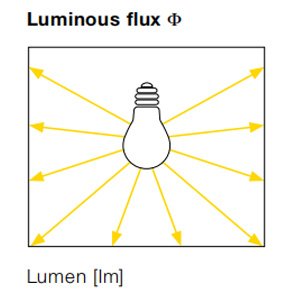
In lighting, the total quantity of light that a lighting device emits is measured in lumens. Lumens are represented as lm. An illumination device’s illumination area increases with its lumen value. The spread or divergence of the light that the gadget is emitting is not taken into account by the lumens unit.
Light Output = Lumens. Simply said, lumens, or lm, are a measurement of the total quantity of light from a lamp or other light source that is visible to the human eye.
WHAT IS CANDELA?

The term “candela” describes the amount of light that a lighting fixture emits in a specific direction. Candlepower is also known as candela. Candlepower measurements date back to a time when candles served as the main source of light. A candle of a given size emits roughly the same amount of light as one candela.
CANDELA VS LUMENS : WHAT IS THE DIFFERENCE?
Although they each measure different properties of a lighting device, lumens and candela are both used in the measurement of lighting. Choosing lighting fixtures that are perfect for your workspace can be made easier if you understand the distinction between lumens and candelas.
When assessing the luminous efficacy of lighting fixtures in industrial environments, we employ both lumens and candelas. The relationship between candelas and lumens is generally represented by the following equation.
Understanding the distinction between candela and lumens will assist you in selecting the right lighting fixture for your building or area that needs to be lit. To light up an area, for example, you would need to install lights in an office building. For employees to walk around smoothly, corridors and storerooms must have the right amount of light.
The device will emit light that is lighter and covers a broader area when its lumen value is higher. However, some staff members might use complex equipment, so they require overhead lighting that shines directly on the items they are handling. In these situations, you’ll need to purchase lighting fixtures after contrasting their candela ratings.
1 candela = 12.57 lumens
WHAT IS FOOT - CANDLE?
DOING YOUR OWN CALCULATIONS
A foot-candle equals one lumen per square foot. This is a British measurement. Using the metric system, a lumen is measured by a square meter or a lux. Thus a foot candle is equivalent to approximately 10 lux or 10.57 lux.
1 foot-candle = 10.57 lux
Now that you know how to convert foot-candles to lumens (Lux) and Watts. it is easy to do the same for your own measurements. Simply substitute 50 for your own measurements.
- To work out Lumens or Lux use the following Equation: Lumens = Foot-Candles x 10.76
- To work out Watts use the following equations or lumens to watts: Watts = Lumens x 0.001496
- You can also calculate the number of watts directly from the foot-candles by combining both equations and using the following: Watts = Foot Candles x 0.01609696 (This is because 10.76 x 0.001496 = 0.01609696)
Calculating and converting is very easy and shouldn’t take very long to do once you get used to it. As the number of lumens is just over 10 x foot candles.
THE LED WATT EQUIVALENT
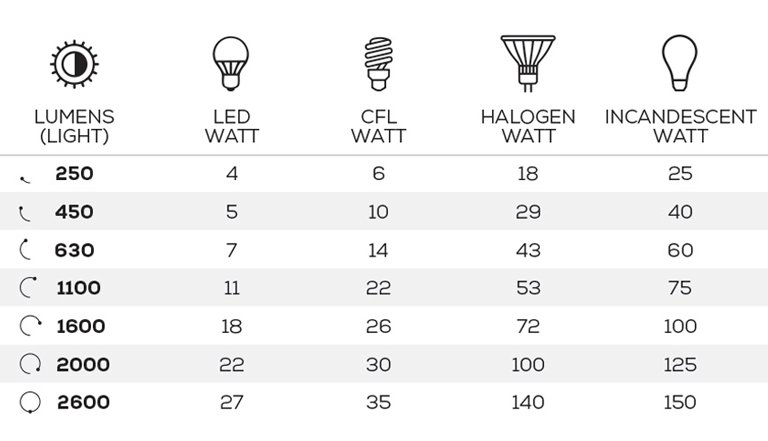
In the transition to more sustainable lighting solutions, LED technology has emerged as a frontrunner, offering enhanced efficiency and longevity. One of the key metrics used to evaluate LED bulbs is their wattage equivalence to traditional incandescent bulbs. To match the brightness of a 60-watt incandescent bulb, an LED bulb typically requires significantly fewer watts. For An LED lightbulb, for instance, may generate the same amount of light as an incandescent bulb, which consumes 60 watts, but it needs a lot less energy—8 to 12 watts.
So to make the long story short, Lumens and Lux are metric candelas and foot candles are imperial lumens and candelas refer to he total light output of a source Lux and foot candles refer to the light falling on an area that is the light illuminating or subject Lux and foot
Candles are more useful to in film and video business and what you’ll see listed in the specs for an industry light that we listed with a distance like 1 meter or 3 feet which is 1 meter but without that distance it’s useless far the way you get from the light the lower the light level goes down so you need to know what distance that missional was taken from otherwise it’s meaningless.
Lighting designers, Interior designers and architects designers have very complicated formulas, softwares and tables that help them figure out the total number of lumens needed to light a huge office space in the day or a large warehouse very important when you have to order thousands if not tens of thousands of fixtures and lights to illuminate every single floor in a skyscraper probably don’t want to get your calculations.
Understanding the 60-Watt Bulb
For decades, the 60 watt bulb (incandescent) reigned supreme as a household staple, casting its warm glow across countless spaces. However, with the advent of energy-efficient alternatives, such as LED bulbs, the focus has shifted from watts to lumens. So, how many lumens does a typical 60 watt bulb emit? The average light output of a 60-watt incandescent light bulb is about 800 lumens. This benchmark serves as a reference point for comparing the brightness of other lighting options
Navigating Lumen to Watt Conversion
As consumers increasingly prioritize energy efficiency and cost savings, understanding the conversion between lumens and watts becomes imperative. While there isn’t a direct correlation between the two, certain guidelines can aid in making informed decisions. As a general rule of thumb, a standard incandescent bulb emits around 14 lumens per watt. However, with advancements in LED technology, this ratio can vary significantly. For instance, modern LED bulbs can produce over 100 lumens per watt, showcasing the remarkable efficiency of these lighting solutions.
Practical Applications:
Armed with the knowledge of lumens and their implications, consumers can make more discerning choices when selecting lighting for their homes or businesses. By prioritizing brightness over wattage, individuals can opt for lower wattage LED bulbs without sacrificing illumination quality. This results in long-term cost benefits in addition to lowering energy use. Moreover, understanding lumens empowers consumers to customize their lighting preferences based on the desired ambiance and functionality of a space
Conclusion:
In the ever-evolving landscape of lighting technology, lumens stand as beacons of clarity amidst the haze of outdated metrics. By embracing lumens as the standard measure of brightness, consumers can embark on a journey towards more sustainable and efficient illumination. From the humble 60-watt bulb to the cutting-edge LED innovations, the concept of lumens illuminates our path towards a brighter, greener future.
By crafting compelling and informative content centered around the keywords “lumens,” “60 watt bulb,” “LED watt equivalent,” and “lumen to watt conversion,” this blog aims to not only educate but also engage readers, establishing itself as a trusted resource in the realm of lighting knowledge. Through strategic optimization and a focus on high-quality, original content, this blog is poised to ascend the ranks and outshine competitors in the digital sphere.
FAQS about lumens in lighting
What are lumens in LED lights?
Lumens = Light Output. In simple terms, Lumens (denoted by lm) are a measure of the total amount of visible light (to the human eye) from a lamp or light source.