

Here are the three steps that apply to most spaces for choosing the perfect Chandelier size:
1. Determine the Chandelier Size
Chandelier Diameter: To find the right diameter for your living room chandelier, use this simple formula: add the length and width of your room in feet. The sum will give you the chandelier’s approximate diameter in inches.
Example: If your dining room measures 14 feet by 10 feet, add 14 + 10 = 24. Your chandelier should be about 24 inches wide.
Measure your room’s length and width, add them together, and you’ll have an easy estimate for the chandelier diameter.
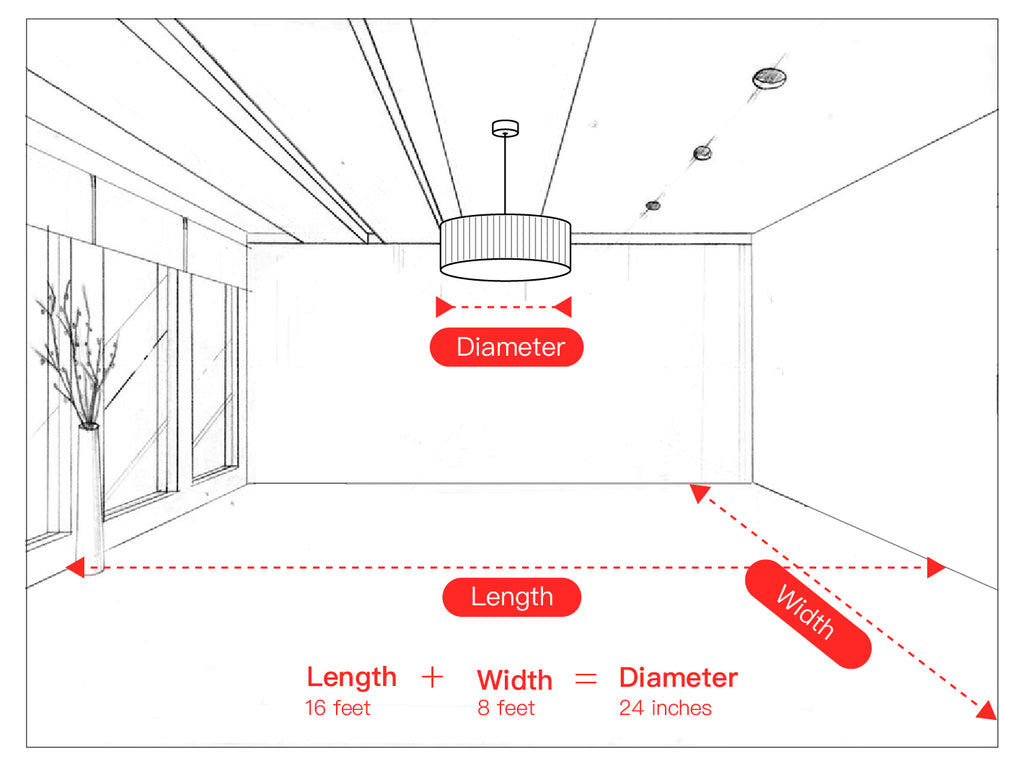
For example, 16 feet (Room Length) + 8 feet (Room Width) = 24 feet; The chandelier should be about 24 inches for its diameter
2. DETERMINE THE CHANDELIER’S HEIGHT
Measure the space’s floor to ceiling distance in feet, multiple by 2.5 will be the approximate height for the chandelier in inches.

For example, 11 feet (Room Height), 11*2.5 = 27.5 The chandelier height living room should be about 27.5 inches for its height
3. Determine How High to Hang Your Chandelier
Height Guidelines: When installing a chandelier, consider how far it will hang from the ceiling. For dining tables, the bottom of the chandelier should be about 30 inches above the table surface. If you’re redecorating, be sure to factor in the height of your new table when planning your lighting.
For open floor spaces, ensure the chandelier’s bottom is at least 7 feet above the floor to allow ample headroom.

If you are hanging the chandelier size over dining table, the chandelier height from dining table top to bottom of chandelier should be 30 to 36 inches away.

Other rules which can apply for a different type of spaces.
Dining Room Chandelier Placement
Choosing the right chandelier height over your dining table requires careful thought. This spot not only lights your dining area but also showcases your personal style. In open floorplans, the chandelier can even set the tone for the entire living space.
Before selecting a fixture, consider both your space and existing furniture. Placement and size are key factors in achieving a balanced look.
Match Chandelier Size to Your Table
A simple guideline is to base the chandelier’s width or diameter on your dining table. Ideally, it should be between half and two-thirds the width of the table. This ensures the fixture complements the table without overwhelming the space.

For example, let’s say that you have a dining table with 32 inches in width and 66 inches in length.
- If you are choosing a round chandelier, its diameter should be between 16 (32 x 1/2) to 21 (32 x 2/3) inches.
- If you are choosing a rectangular chandelier, its width should be between 16 to 21 inches and length should be 33 to 44 inches (Same here 1/2 to 2/3 of the dining table length)
TWO-STORY FOYER WITH STAIRCASE
For Chandelier size for hallways besides the general rule that the chandelier’s bottom should be at least 7 and a half feet away from the floor. For two stories, what you also need to consider is how will it look from the second floor. In general, staircase chandeliers will be a good choice for space. In term of placing, below are two commonly seen guidance:

- The general guideline is to use the second floor as a reference point. Hanging the chandelier slightly lower than or at the top of the staircase. This way, when you are at the top of the staircase, the top of the chandelier will be at your eye level.
- On the other hand, many designers advocate for independent placement just to make the chandelier the focal point or to place the chandelier about another architectural feature. For example. if there is a large transparent window above the door, it should be centered in the window for the best visual result from outside.
LONG HALLWAYS
Chandelier size for hallways should be determined by the width of the hallway. Multiple the hallway’s widths in feet by 2.5 will be the diameter of the chandelier in inches.

For example, the hallway’s width is 8 feet. The chandelier’s diameter should be about 20 (8 x 2.5) inches
If you want to decorate with a chandelier for your long hallways. We always recommend having them
- Centered in the middle of the hallway
- Spaced between 8 and 10 feet apart
- At least 7 and a half feet clearance from floor to bottom of the chandelier.
Credits: sofary.com


