
Lighting a kitchen can be challenging, whether you are building a new one or renovating an existing space. The right lighting ideas can transform the ambiance and mood of the kitchen, especially when paired with the correct color temperature.
Why Kitchen Lighting Matters
Today, homeowners face a huge variety of kitchen lighting ideas. With so many choices, it can be hard to know where to begin. That’s why we’ve put together some essential kitchen lighting design rules of thumb to guide you through the renovation process.
Kitchen Lighting Options
Kitchen lighting comes in many styles, designs, and features. Whether you are starting from scratch or refreshing your kitchen, the right lighting makes a huge difference.
Even if you search for kitchen lighting ideas for small kitchens or kitchen lighting ideas for low ceilings, the results may not always give you reliable solutions. That’s why we created this post—to help you explore practical and stylish kitchen lighting rules of thumb.
Think about the atmosphere and task areas where you want to illuminate
The kitchen is a multi-functional space. Good lighting allows you to shift the mood from focused, task-oriented areas to relaxed, social zones. It can transform a busy prep area into a cozy home office or dining spot with ease.
To get started, let’s break down the key layers of kitchen lighting:
Task Lighting: Provides focused light for specific activities like reading a recipe or chopping vegetables.
Accent Lighting: Highlights key features or zones, such as artwork, shelving, or dining areas.
Ambient Lighting: Creates overall balance and harmony, making the kitchen feel welcoming and comfortable.
Feature Lighting: Adds personality and a focal point, such as a striking pendant over an island.

01. Task lighting for working areas
Task lighting focuses on the main working zones in your kitchen, such as food preparation counters or the dining table. We recommend using a diffused, even light source under cupboards to avoid harsh shadows.
Be mindful of obstructions or unshielded lights, as these can create unwanted spots or lines on reflective surfaces like backsplashes. Installing kitchen unit lighting is an effective way to ensure proper illumination for daily tasks.

Always place task lighting in front of you to avoid half shadows on countertops. Decorative pendants are a great way to provide functional light while adding style and mood to your kitchen.
Make sure tables used for food prep, cooking, or dining are well lit. Flush recessed downlights create a sleek, modern look. If recessed installation isn’t possible, surface-mounted directional spotlights are a smart alternative.
Only add light where necessary to prevent cluttered grids on the ceiling. Scalloped light patterns can look attractive, but incorrectly offset lighting may create uneven shadows.
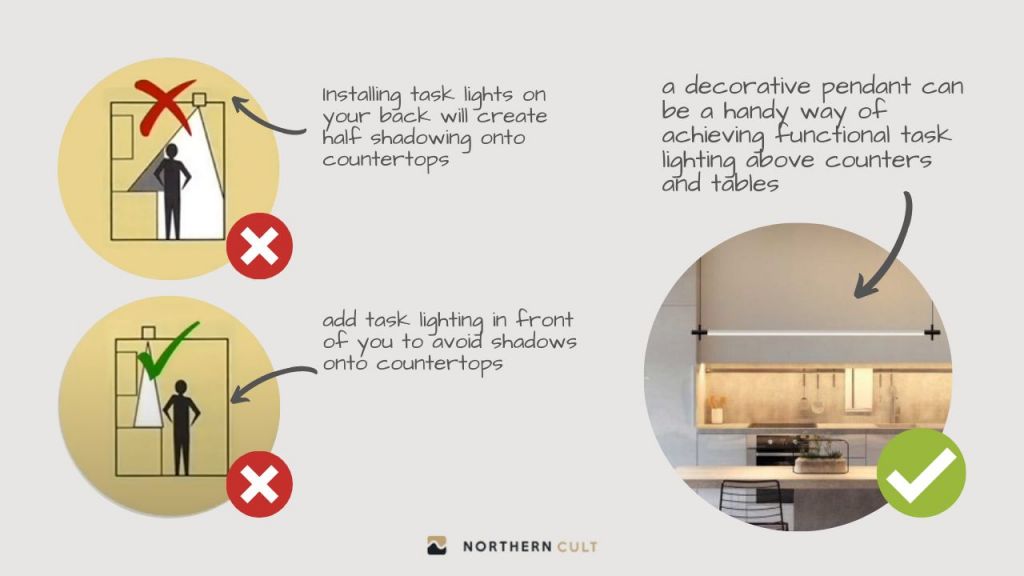
Remember to add task lighting in front of you otherwise, you will create half shadowing onto countertops a decorative pendant can be a handy way of achieving functional task lighting above counters and tables in addition to adding an injection of mood and style to the kitchen. Try using the latest pendant kitchen lighting ideas, kitchen lighting ideas on island for task lighting will make kitchen lighting design better.

02. Accent lighting to create point of interest around the kitchen
Accent lighting that guides the eye and creates points of interest around the kitchen illuminating paintings or sculptures. This can be achieved via down lighting from the ceiling careful consideration of offsets is recommended for the best light quality localized lights such as a picture light can also be used decorative wall lights can be a nice touch to add rhythm and focus to otherwise bare walls.
In addition to providing atmosphere and influencing mood, accent lighting is used to highlight architectural features and important objects, and to draw attention away from the things that aren’t as pleasing. Searching for recessed kitchen lighting ideas, ceiling kitchen lighting ideas can give better understanding for accent lighting.

image source : houzz.com
03. Ambient lighting for sense of warmth and depth
Ambient lighting that improves the sense of warmth and depth in a room ensuring that the kitchen feels welcoming and comforting we recommend providing comfortable levels of illumination while avoiding glare or harsh direct light sources. A clever way of adding diffused light to a space without having to build any details within the ceiling is via indirect uplighting from decorative pendants it is also a handy way to make a space feel larger and more open a common technique.
When introducing Ambient light into the kitchen is the use of coffees and coves because they create an indirect perimeter of light that washes the room one thing to remember is to allow sufficient spacing to ensure that the light creates a soft glow otherwise you’ll be stuck with a harsh band of light and won’t gain much useful light from that detail up lighting from existing joinery can be an effective way to add ambient lighting to the soffit.
Remember again to allow for enough space in the detail for the light to soften across the ceiling diffuse decorative light sources allow for flexibility and a personalized touch to the kitchen small table lights can be an effective technique when evoking a mood or adding a touch of elegance to your kitchen table
04. Feature lighting to make a statement
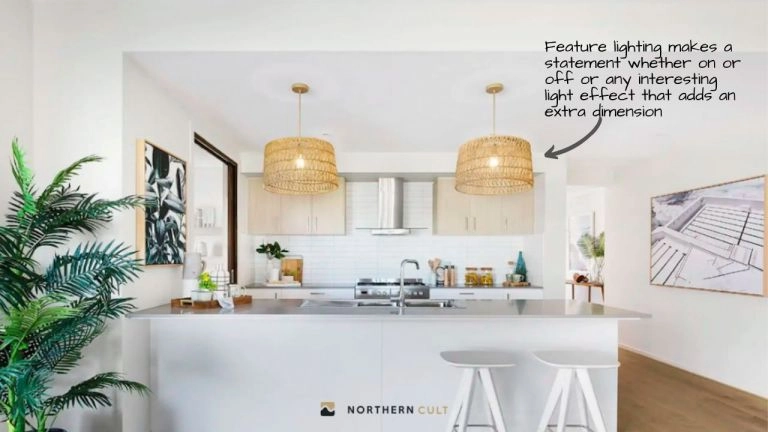
Feature lighting gives an opportunity to make a statement and give the space personality it can also add to overall light levels feature lighting can refer to the fitting itself which makes a statement whether on or off or any interesting light effect that adds an extra dimension but is not absolutely essential.
Decorative pendants in finishes and materials of your choice are good examples of feature lighting if you need useful lighting from your pendant, however, you may also need to check its lighting output miniature uplights to the window reveal are wonderfully dainty details that can add a bit of drama to the kitchen thank you for listening to this an installment in our dark art of light series
Kitchen Lighting Design Rules of Thumb
To make thing short while considering the kitchen lighting design rules of thumb, here are the six points to make kitchen lighting design better.
Prepare a basic lighting plan incorporating all your needs and atmosphere you want to create
Check whether all four layers of lighting can be incorporatred, ie Ambient lighting, Accent lighting, Task lighting and Feature lighting
Choose the right color temperature, energy consumption and Color rendering.
Match Light Fixture Styles With the Overall Kitchen Lighting Design Scheme
Opt for Dimmers Whenever Possible
Don’t Overload the Space With Too Many Light Fixtures
FAQs about Kitchen Lighting Design Rules of Thumb
What is the best lighting for a kitchen ceiling?
Are LED lights good for kitchen?
How many lumens should you have in a kitchen?
Average lux on Task areas in the kitchen: 500 lux
Average lux on general areas in the kitchen: 300 lux
What color LED light is best for kitchen? Should kitchen lights be warm or cool?
What is the best color for under cabinet lighting?

Download Our Free Ebook Now!
This contact form is available only for logged in users.



Pingback: HOW TO START GUEST BLOGGING WITH NORTHERNCULT | NorthernCult
Pingback: 2021 - THE BEST HOME LIGHTING BLOG - IDEAS & TIPS %