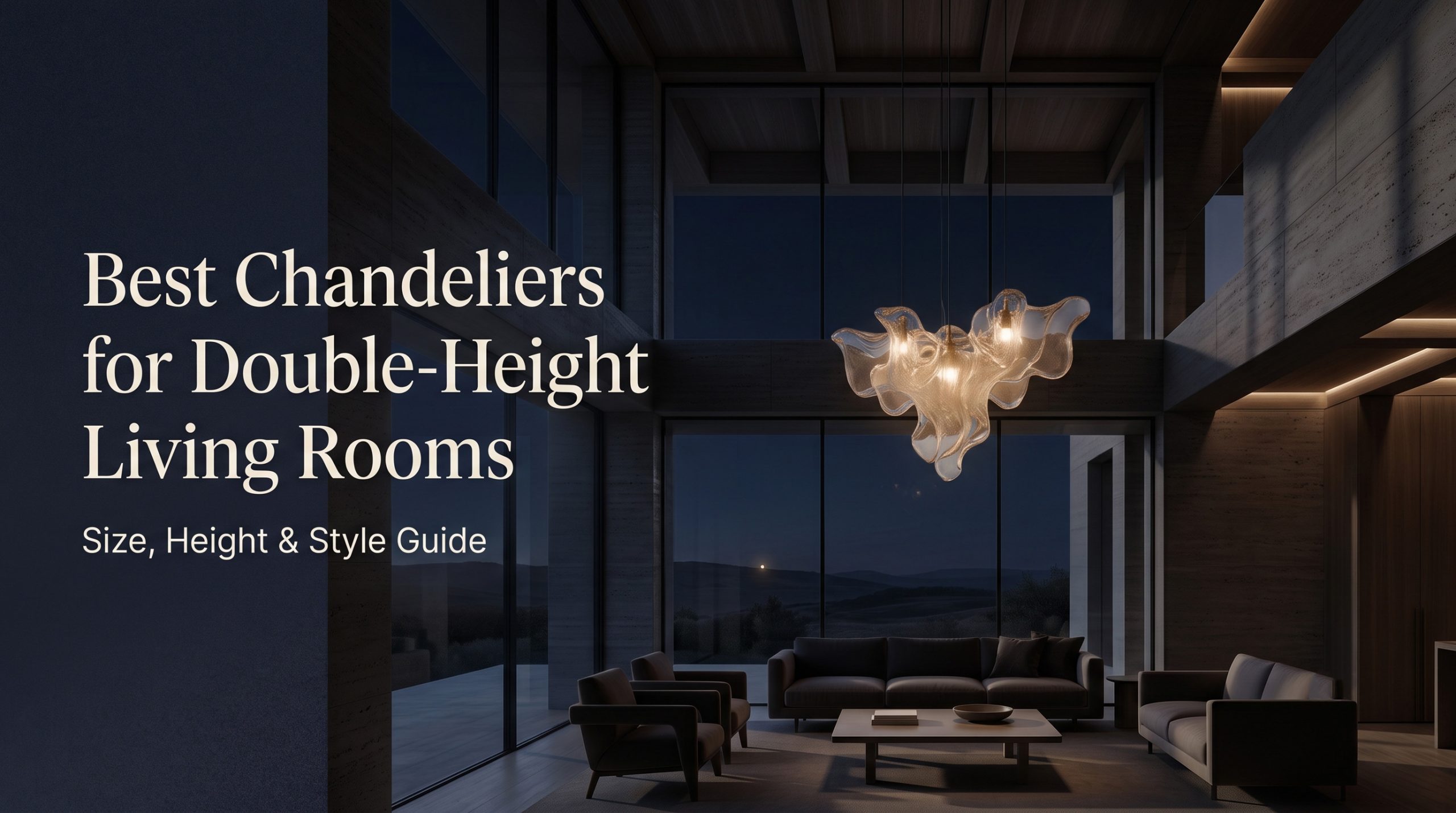
A double-height living room gives you something a standard room cannot: volume.
That extra height can make a chandelier one of the strongest architectural features in the entire interior. But it also makes choosing the right fixture much less forgiving.
One of the most common problems we see is a chandelier that looked substantial in a product image becoming surprisingly small once it is installed in a tall room.
The opposite can happen too. Choosing the largest chandelier available does not automatically create a better result.
At Northern Cult, we prefer to approach a chandelier for a double-height living room as part of the architecture rather than simply as a decorative light fitting.
The ceiling height matters, but so do the width of the room, furniture position, staircase or mezzanine, viewing angles, chandelier drop and the visual weight of the fixture.
The aim is not simply to fill empty space.
The chandelier should feel as though it belongs there.
Why Double-Height Living Rooms Need a Different Chandelier
In a standard-height living room, a chandelier is usually experienced mainly from below.
A double-height space changes that.
The fixture might be visible from:
- The main seating area
- The entrance to the room
- A staircase
- An upper-floor corridor
- A mezzanine or balcony
- Adjacent open-plan spaces
This means the chandelier has to work from several viewpoints rather than only one.
Width becomes important, but vertical proportion becomes equally important.
A chandelier can technically be large and still look too small because its body is too shallow for the height of the room.
That is why we rarely recommend choosing a double-height chandelier by diameter alone.
Start With the Room, Not the Chandelier
When somebody asks us what size chandelier they need for a double-height living room, we do not immediately start with a diameter.
We first try to understand the space.
Ideally, we want to know:
- Ceiling height
- Room width and length
- Position of the chandelier point
- Furniture arrangement
- Staircase position
- Mezzanine or upper-floor openings
- Main viewing directions
- Photographs of the room
- Architectural plans or renders if available
Two rooms with identical ceiling heights can require completely different chandeliers.
A narrow vertical void may suit a long cascading composition.
A wider living room with the same ceiling height may need something much broader to visually anchor the seating area.
The room should determine the chandelier rather than the chandelier determining the room.
How Big Should a Chandelier Be in a Double-Height Living Room?
There is no single measurement that guarantees the correct chandelier size.
Traditional room-size formulas can be useful as an initial reference, but we would not use them as the final decision for a large double-height interior.
You need to consider three things together:
- Width
- Vertical presence
- Visual weight
Chandelier Width
The chandelier needs enough width to relate to the space beneath it.
If it hangs over a seating arrangement, we normally look at the scale of that zone rather than automatically sizing the chandelier against the entire room.
A fixture that is too narrow can feel disconnected from the furniture below.
However, simply increasing the diameter is not always the answer.
A dense glass chandelier and a very open metal chandelier can have exactly the same dimensions while feeling completely different once installed.
Vertical Drop
This is one of the most important differences between a normal living room and a double-height one.
A chandelier with a short body and short suspension can remain visually stuck to the ceiling.
You then have a large amount of unused space between the chandelier and the actual living area.
For tall rooms, we often prefer chandeliers that make use of that vertical volume.
That could mean a longer suspension, multiple levels or a cascading composition.
Visual Weight
Actual dimensions do not always tell you how large a chandelier will appear.
A large open-frame fixture may feel visually light.
A smaller fixture made from dense glass, multiple lamps or substantial decorative elements can feel much heavier.
This is why we consider both physical scale and visual scale.
A Two-Tier Chandelier Can Work Well in Wider Double-Height Rooms
A two-tier chandelier is particularly useful when you want both width and some vertical structure.
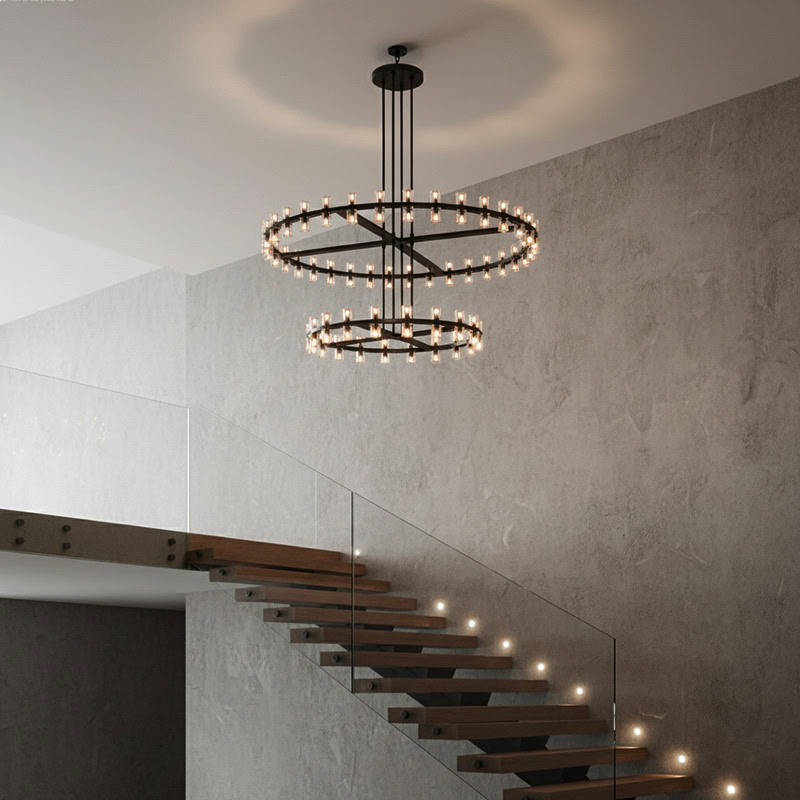
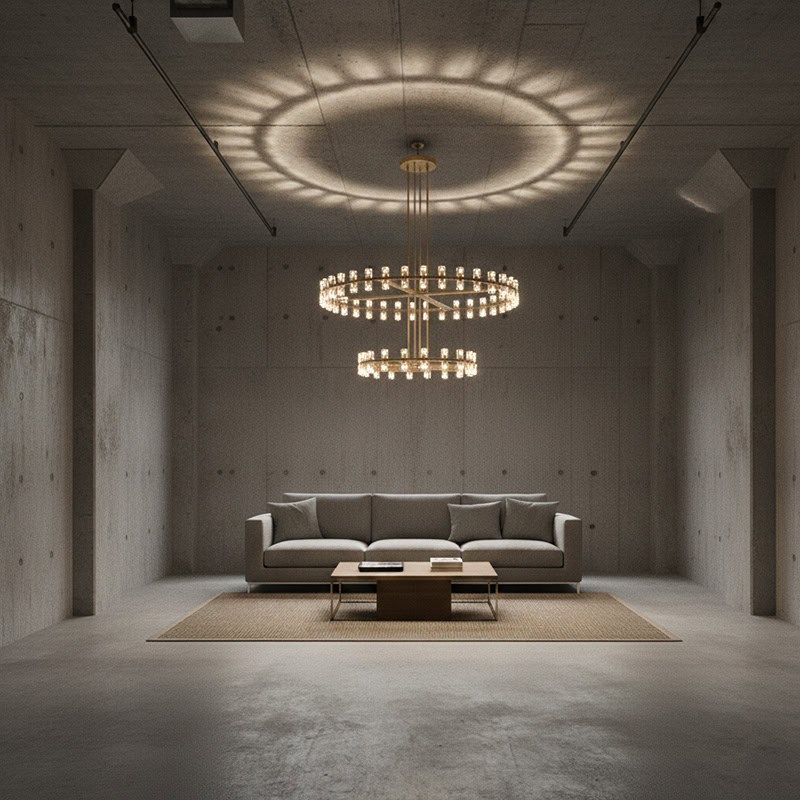
The WOLFOS LG219 Two-Tier Decorative Light Fixture is a good example.
Its two different ring levels create a stronger vertical relationship than a single flat chandelier while still maintaining enough width to anchor a larger room.
This kind of composition can work especially well in broad double-height living rooms where an extremely narrow cascading chandelier may not have enough horizontal presence.
How Low Should a Chandelier Hang in a Double-Height Living Room
There is no universal hanging height that works in every room.
The correct drop depends heavily on what happens underneath and around the chandelier.
If people regularly walk below the fixture, comfortable clearance is essential.
If the chandelier hangs above a seating area with no circulation beneath it, you may have much more freedom to bring the fixture lower.
You should also consider the upper floor.
A chandelier that looks perfectly positioned from the ground floor can look awkward when viewed from a staircase or mezzanine.
In double-height interiors, we like to evaluate the chandelier from both levels before deciding the final suspension length.
The lowest point should feel connected to the living space without making the chandelier feel as though it has been pulled too far downward.
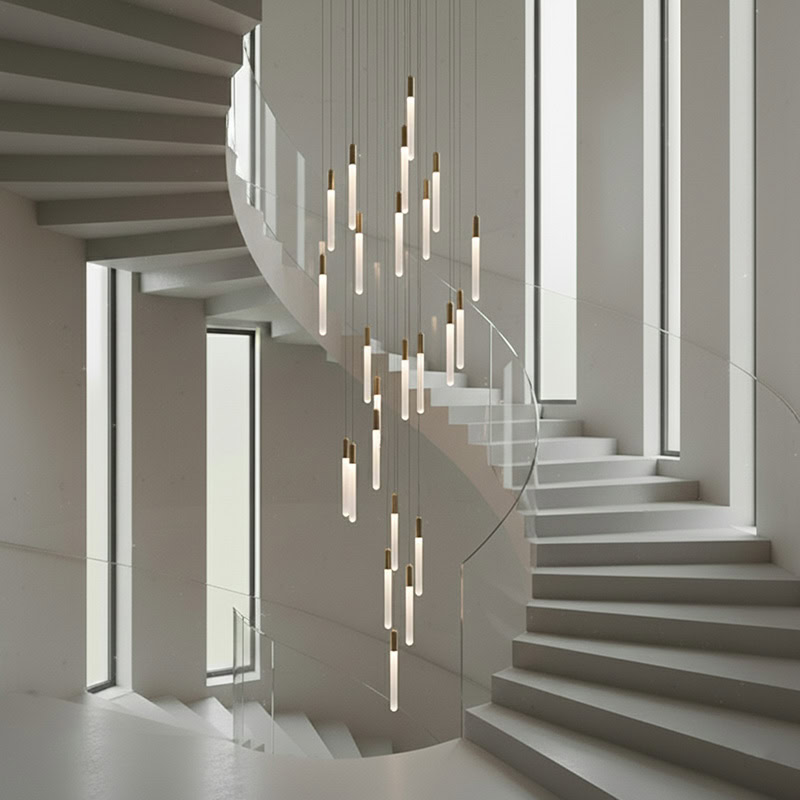
Tall Spaces Often Need Vertical Chandeliers
Some double-height interiors are more vertical than wide.
In those situations, increasing chandelier diameter may not solve the problem.
A long composition can be much more effective.
The VIDRO LG238 Minimalist Hanging Tube Chandelier demonstrates this idea well.
Multiple suspended elements allow the fixture to occupy the height of the space instead of concentrating everything close to the ceiling.
This approach works particularly well in:
- Staircase voids
- Narrow double-height living rooms
- Entrance voids
- Tall atriums
- Spaces viewed from multiple floors
Circular Chandeliers Work Well in Broad Open Spaces
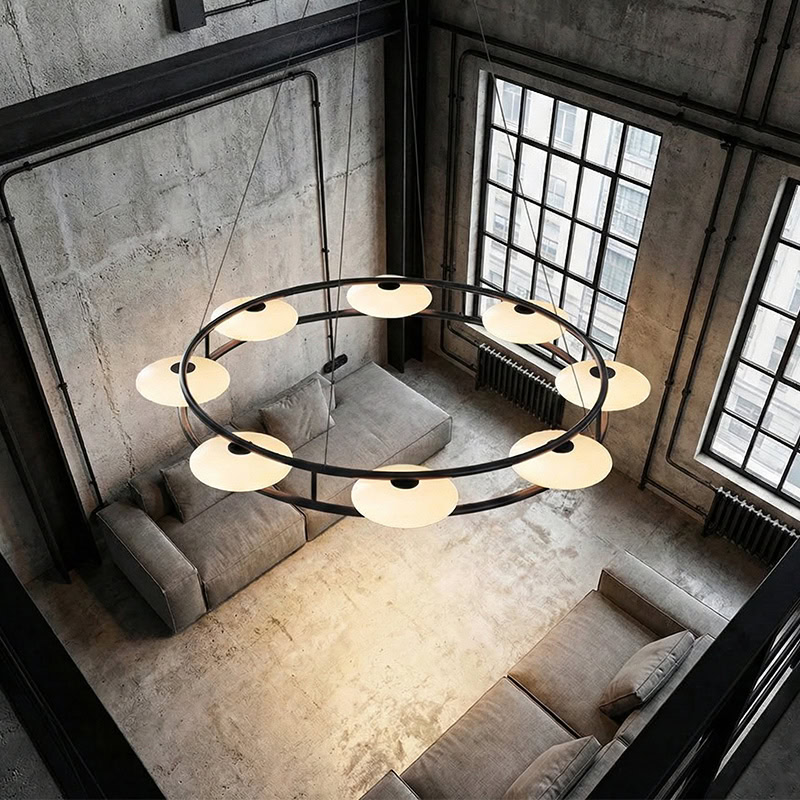
When a double-height living room is wide rather than narrow, a broad circular chandelier can create a strong visual anchor.
The FOSCHO LG295 Eye-Inspired Modern LED Ring Chandelier is an example of a fixture with a strong horizontal composition.
Circular designs can work especially well above:
- Large seating arrangements
- Central conversation areas
- Symmetrical living rooms
- Open-plan spaces where the chandelier defines the living zone
The important point is not simply to choose the largest ring available.
The diameter should relate to the furniture and architecture underneath it.
Modern Double-Height Rooms Can Take More Architectural Forms
Not every statement chandelier needs glass, crystals or multiple illuminated elements.
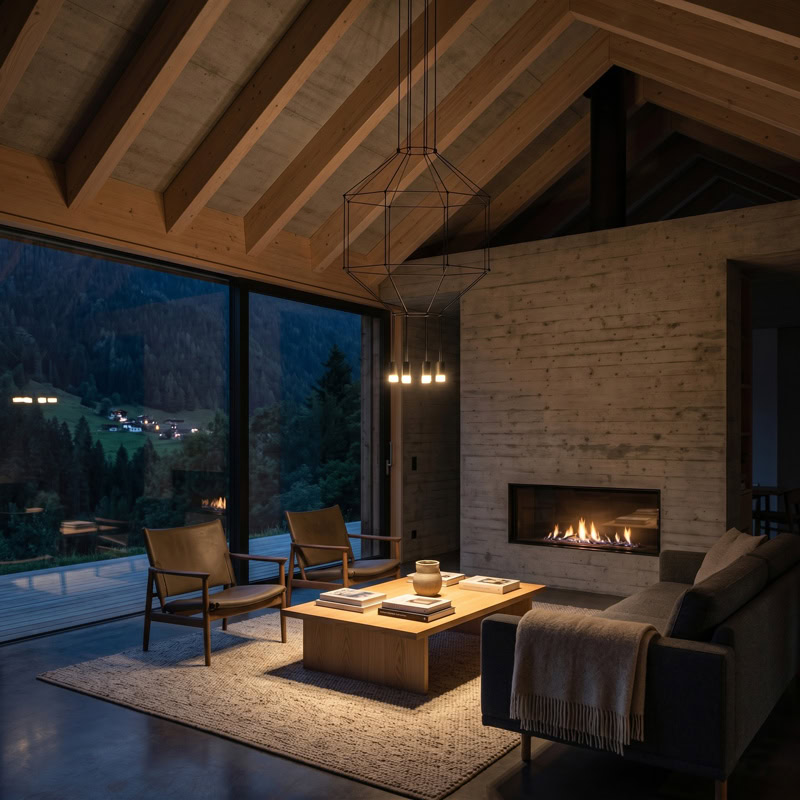
For minimalist architecture, sometimes the chandelier itself can become an architectural drawing suspended in the room.
The NOVARA LG373 Geometric Frame Pendant Light uses a much lighter geometric structure.
This type of fixture can be useful when the architecture already has strong materials, exposed timber, concrete or large windows and you do not want the chandelier to visually overpower them.
A large fixture does not necessarily need to look heavy.
What Type of Chandelier Is Best for a Double-Height Living Room?
There is no single best design.
The shape of the room should influence the shape of the chandelier.
Cascading Chandeliers
Cascading chandeliers are particularly effective when there is significant vertical space.
They allow individual elements to occupy different heights, creating a visual connection through the room.
Multi-Level Chandeliers
Two-tier and multi-tier chandeliers work well when you need both width and vertical presence.
They can be particularly effective in large living rooms with a broad seating arrangement.
Large Circular Chandeliers
Circular and ring chandeliers can visually anchor a large open space and create a strong central focal point.
Cluster Chandeliers
Clusters are useful when the composition needs more flexibility.
Individual pendants can often be arranged at different levels to suit the architecture.
Geometric Chandeliers
Open-frame and geometric forms can provide substantial scale while keeping the interior visually light.
Double-Height Living Rooms With Staircases Need Extra Planning
A staircase completely changes how a chandelier is experienced.
Rather than seeing the fixture from one fixed position, you move past it at several different heights.
That can produce some of the most impressive chandelier installations, but it also means more things need to be considered.
You need to think about:
- Head clearance
- Handrail position
- Upper-floor sightlines
- Suspension length
- Access for installation
- Maintenance
- What the chandelier looks like from its side
- What the chandelier looks like from above
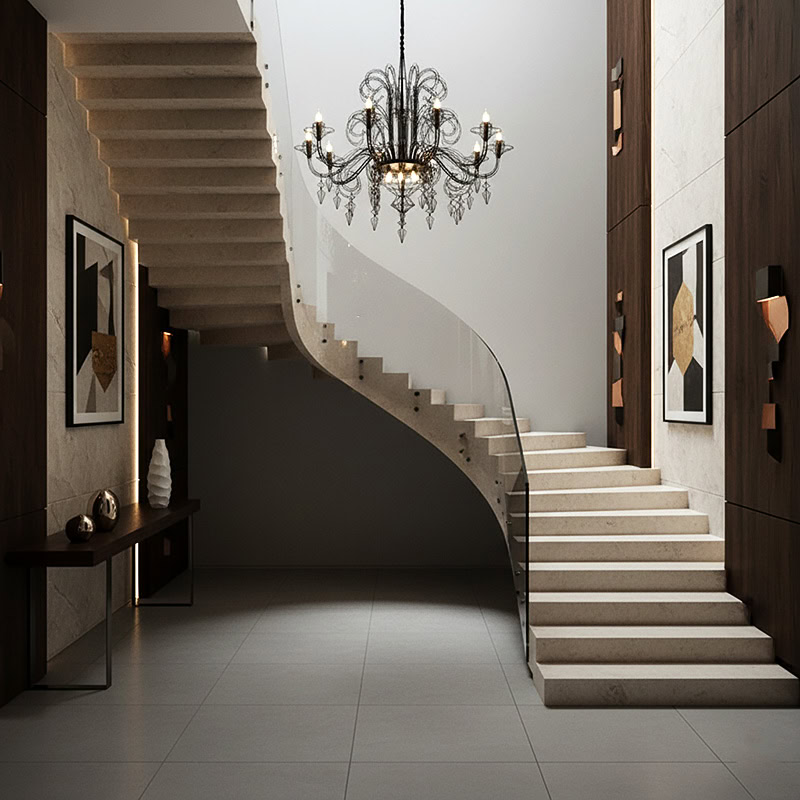
The LUXURIA LG198 Modern Staircase Chandelier illustrates a more traditional chandelier form used within a tall staircase environment.
The important point is that staircase chandeliers are not only viewed from beneath.
The upper part of the fixture, suspension and overall construction become much more visible.
Should You Choose a Custom-Size Chandelier?
Double-height rooms are one of the situations where customization can make a significant difference.
That does not necessarily mean designing an entirely new chandelier.
Sometimes the most useful customization is simply changing:
- Overall suspension length
- Diameter
- Number of hanging elements
- Cable lengths
- Vertical arrangement
- Finish
- Lighting configuration
We normally recommend customization when it solves an actual proportion problem.
For example, a tall narrow room may not need a wider chandelier at all.
It may simply need a longer version of the same composition.
A broad double-height room may require exactly the opposite.
Customization should respond to the architecture rather than simply making the chandelier bigger.
Should a Chandelier Be the Main Light Source?
Not necessarily.
In many double-height living rooms, we prefer the chandelier to be part of a layered lighting scheme rather than asking it to illuminate the entire room by itself.
A good lighting scheme may combine the chandelier with:
- Recessed lighting
- Concealed architectural lighting
- Wall lights
- Floor lamps
- Accent lighting
This gives you more control over the atmosphere.
It also prevents the chandelier from becoming excessively bright simply because the room is large.
For many residential interiors, warmer lighting around 2700K to 3000K works particularly well, although the correct choice depends on the surrounding materials and other light sources.
Dimming is also worth considering wherever possible.
Plan the Installation Before Ordering
A double-height chandelier should ideally be planned before the final stages of construction.
Check the Ceiling Structure
Large chandeliers need an appropriate fixing point.
Heavy decorative fixtures should not be treated like ordinary lightweight pendant lights.
If the house is still being built, chandelier loads and fixing positions should be coordinated early with the appropriate contractor or professional.
Confirm the Electrical Position
The best chandelier position is not always the geometric center of the room.
It often needs to align with the furniture or architectural composition below.
This is especially important in large open-plan interiors.
Check the Available Suspension
A chandelier body can have the perfect proportions while the supplied suspension is too short for the room.
Always verify the required total drop before ordering.
Think About Access
Installation in a double-height space may require scaffolding or specialist access equipment.
Future maintenance should also be considered.
Common Mistakes When Choosing a Double-Height Chandelier
Choosing a Chandelier That Is Too Small
This is probably the most common issue.
A chandelier looks large online but becomes visually lost once installed in a much larger architectural volume.
Looking Only at Diameter
Width is only part of the equation.
Vertical drop can be just as important.
Hanging the Chandelier Too High
When a chandelier remains very close to the ceiling, it may feel disconnected from the room below.
Automatically Choosing the Largest Fixture
Double-height does not mean unlimited scale.
A chandelier can dominate a room just as easily as it can disappear within one.
Ignoring the Upper-Level View
The fixture may be seen almost at eye level from the first floor.
That changes how important the suspension, canopy and upper construction become.
Selecting the Chandelier Too Late
Waiting until construction and electrical work are complete can unnecessarily restrict placement, suspension and customization options.
Can a Chandelier Be Too Large for a Double-Height Living Room?
Yes.
A tall ceiling does not automatically justify an oversized chandelier.
The goal is proportion.
A highly decorative, visually dense chandelier can dominate minimalist architecture even when its dimensions technically fit the room.
In many projects, a simpler chandelier at the correct scale creates a stronger result than a much more elaborate fixture.
Scale should support the architecture, not compete with it.
What Information Should You Send Before Choosing a Chandelier?
If you are unsure which chandelier will work in your double-height living room, having a few basic details makes the decision considerably easier.
We recommend providing:
- Ceiling height
- Room width and length
- Photos of the interior
- Floor plans or renders where available
- Intended chandelier position
- Staircase or mezzanine location
- Approximate furniture arrangement
- Examples of chandelier styles you like
With this information, it becomes easier to decide whether a standard fixture will work or whether the size, suspension or configuration should be adjusted.
Explore Chandeliers for Double-Height Spaces
Northern Cult offers chandeliers ranging from wide sculptural fixtures to long-drop and staircase compositions.
You can explore the full Northern Cult chandelier collection and compare designs according to the proportions of your space.
For larger or unusually proportioned interiors, we recommend looking beyond product dimensions alone.
Think about how the chandelier will occupy the room.
Our Advice Before You Order
For a double-height living room, do not choose the chandelier in isolation.
Choose it in relation to the architecture.
Scale matters.
Vertical drop matters.
Viewing angles matter.
The staircase matters.
The furniture underneath matters.
And sometimes changing the suspension or configuration makes a much greater difference than simply choosing a larger fixture.
If you are uncertain, send us the ceiling height, room dimensions, photographs and plans where available.
We would rather help you get the proportion right before ordering than try to solve an incorrectly scaled chandelier after installation.
The best chandelier for a double-height living room should not simply look impressive in a product photograph.
It should look as though the room was designed around it.