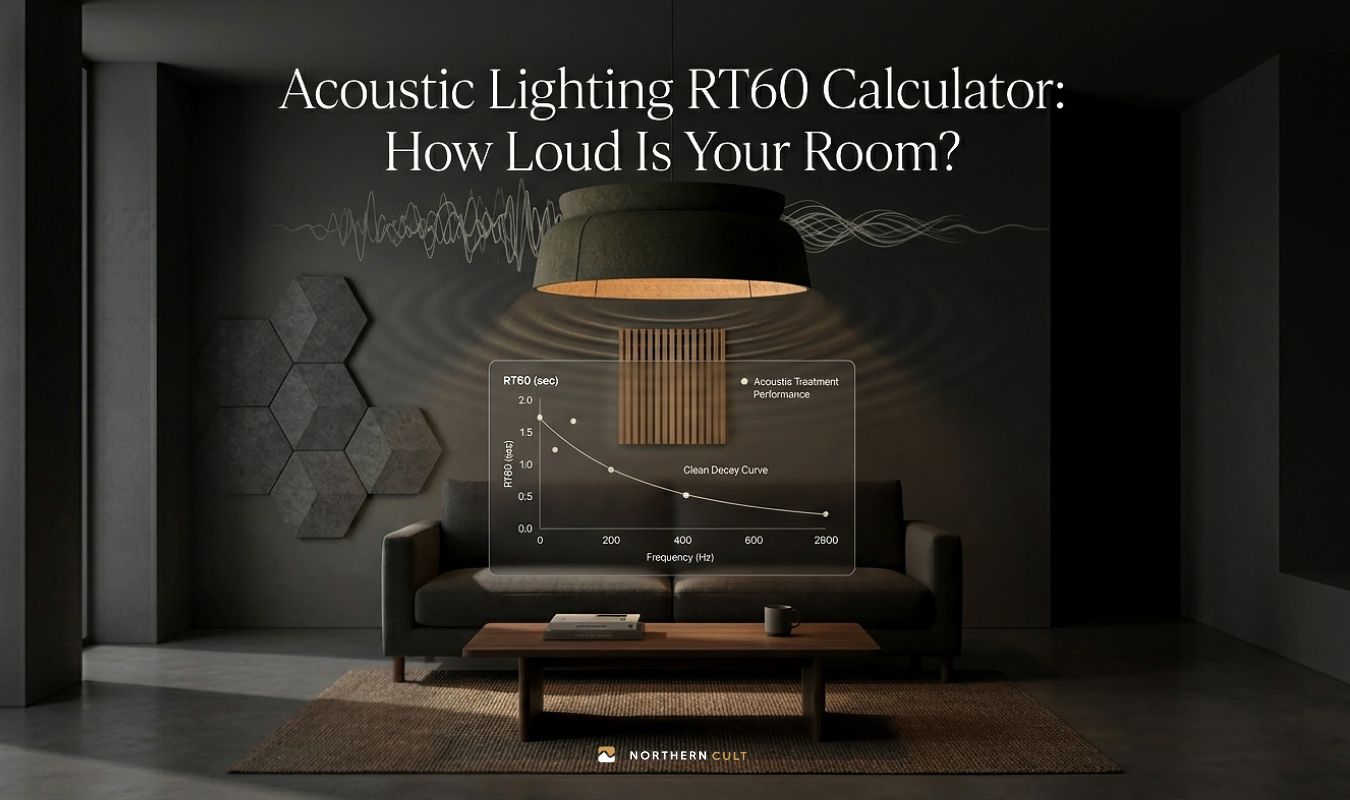
Acoustic Lighting RT60 Calculator
Enter your room dimensions and materials to see your reverberation time — before and after NorthernCult acoustic lights.
Why Your Space Sounds Worse Than It Looks
You've invested in beautiful furniture, freshly painted walls, and a perfectly considered layout. But the moment people fill the room — a dinner, a meeting, or a busy afternoon at home — it becomes unbearably loud. Conversations blur. People raise their voices just to be heard. Sound designers call this the Lombard Effect. Interior designers call it a problem.
The culprit is almost always reverberation — sound bouncing between hard surfaces like floors, ceilings, and glass. And the ceiling, the largest untreated surface in most rooms, is usually the biggest offender.
This is exactly what acoustic lighting was designed to solve. Instead of adding bulky acoustic panels as an afterthought, acoustic light fixtures absorb sound while delivering beautiful, designer-grade illumination. One fixture. Two functions. Zero compromise on aesthetics.
What Is RT60 — And Why Does It Matter?
RT60 is the gold-standard measurement of a room's acoustic character. It stands for Reverberation Time 60dB — the number of seconds it takes for a sound to decay by 60 decibels after its source stops. Clap your hands once in a room and time how long the echo lingers. That's roughly your RT60.
"A room that looks beautiful but sounds terrible will always feel uncomfortable. Acoustic lighting is the rare solution that treats both problems at once — without compromising on design."
The higher the RT60, the louder and more chaotic a space feels. Speech clarity drops dramatically above 0.8 seconds. Restaurant diners report lower satisfaction. Office workers make more errors. Students retain less. The acoustic environment is not a luxury concern — it is a fundamental quality-of-life issue.
RT60 is calculated using Sabine's Formula: RT60 = 0.161 × Volume ÷ Total Absorption (sabins). This is exactly what the calculator above does — automatically.
RT60 Target Guide by Space Type
| Space Type | Target RT60 | Status if Exceeded | Primary Need |
|---|---|---|---|
| Recording studio | 0.2 – 0.4s | Critical | Total silence |
| Office / co-working | 0.4 – 0.6s | Noisy | Focus & clarity |
| Conference room | 0.5 – 0.7s | Noisy | Speech intelligibility |
| Restaurant / café | 0.8 – 1.2s | Too loud | Ambient comfort |
| Residential living room | 0.4 – 0.6s | Noisy | Warmth & calm |
| Hotel lobby | 0.6 – 1.0s | Noisy | Impressiveness + clarity |
| Auditorium | 1.2 – 2.0s | Intentional | Musical warmth |
How Acoustic Lighting Works
Acoustic lights aren't magic. They work through well-established acoustic physics, packaged inside beautiful, functional light fixtures.
Sound hits the fixture
Sound waves travel outward in all directions. The acoustic felt or foam integrated into the fixture intercepts waves before they reach the hard ceiling.
NRC — absorption coefficient
NRC (Noise Reduction Coefficient) determines how much sound is absorbed vs reflected. NorthernCult fixtures use high-density felt with NRC 0.65–0.85.
Surface area is everything
More fixture surface area = more absorption. Multiple acoustic pendants or a large linear fixture significantly reduces RT60.
Light + acoustics together
Unlike passive panels competing for ceiling space, acoustic lighting combines both functions. One installation. No visual clutter. Full illumination maintained.
Right Fixture for Each Space
Not every room needs the same approach. Here's how to match the right NorthernCult acoustic fixture to your specific space and noise challenge.
Open-plan office
Largest noise problem. Multiple conversations, phone calls, keyboard noise. Needs maximum absorption across ceiling plane.
Restaurant / café
Hard floors, glass, dense seating. Diners raising voices — the classic echo problem that drives customers away.
Conference / boardroom
Speech clarity is critical. Poor acoustics means 30% more miscommunication. Small room, high impact.
Home living room
Modern interiors with minimal soft furnishings can be surprisingly echoing. Adds warmth and calm without bulk.
Hotel lobby
High ceilings, marble floors, glass — dramatic but acoustically punishing for guests and front-desk staff.
Classroom
Students learn measurably better when RT60 is below 0.6s. Acoustic lighting here has a direct educational impact.
Acoustic Lighting vs Acoustic Panels
Both solve the same core problem — too much reverberation. But they do it very differently.
| Acoustic panels | Acoustic lighting (NorthernCult) | |
|---|---|---|
| Sound absorption | Good (NRC 0.7–0.95) | ✓ Good (NRC 0.65–0.85) |
| Illumination | ✗ None — separate fixtures needed | ✓ Full LED integrated |
| Ceiling space | ✗ Competes with light fixtures | ✓ Single installation |
| Aesthetics | Functional / industrial | ✓ Designer-grade decorative |
| Installation | Two separate installs | ✓ Single electrical fit |
| Cost | Panels + fixtures = double cost | ✓ Single combined budget |
| Residential use | Rarely — too clinical | ✓ Yes — pendant and wall styles |
The NorthernCult Acoustic Collection
Every fixture in our acoustic series pairs high-density sound-absorbing felt panels with precision LED illumination. Available in three form factors to suit any space.
TACE LG163 / LG162 / LG274 / LG244
The most versatile acoustic fixtures. A single large pendant adds 1.2–3.5 sabins. Groups of 3–6 reduce RT60 by 25–40% in a standard room.
Shop Acoustic Pendants →TACE LG239 / LG240 / LG241 / LG246
The workhorse of commercial acoustic lighting. Large felt surface area delivers maximum absorption per fixture. Ideal for offices and classrooms.
Shop Acoustic Linears →TACE LG272 / LG245
Brings acoustic treatment to vertical surfaces — ideal for low-ceiling spaces or as a complement to ceiling fixtures. From $449.
Shop Acoustic Wall Lights →TACE LG242 / LG273 / LG243
Custom hexagonal and modular configurations. Start with one unit and expand coverage as needed. From $613.
Shop Modular Acoustics →Ready to calm your space?
Browse NorthernCult's full acoustic lighting collection — pendants, linears, wall fixtures and modular systems for every space.
Shop Acoustic Lights →Frequently Asked Questions
Shop chandeliers and acoustic lights that transform your space >>